

Updated: November 25, 2025
When planning a meal, many people start by choosing the cut of steak—debating the merits of a strip steak versus a filet. But just as important as the cut is the quality of the meat itself. Do beef grades really matter? And how do they affect taste, tenderness, and flavor? In this guide, we’ll break down everything you need to know about the USDA’s grading system, what each grade means, and how it can help you make the best choice when buying beef.
Table of Contents
How Does the USDA Grade Beef?
USA Beef Quality Grading Scale
Prime Grade
Choice Grade
Select Grade
Yield Grades: Maximizing What You Actually Eat
How Does Wagyu Grading Compare to USDA?
Why You Should Care About Beef Grades
Frequently Asked Questions About Beef Grades
How Does the USDA Grade Beef?
The United States Department of Agriculture (USDA) is tasked with evaluating beef produced in the U.S. The organization makes its assessments based on two primary characteristics:
- Quality: How tender, juicy, and flavorful the meat is
- Yield: How much usable/saleable meat a butcher gets from the cow
USDA beef grades have become a widely recognized symbol that consumers rely on as they shop and dine out. Understanding what Prime means versus a cut labeled Choice or Select not only gives you an idea of how tender or tasty that meat will be, but it also helps guide your prep and cooking processes — after all, you wouldn’t necessarily treat a Prime cut the same way you’d treat a Choice cut.
It’s important to note that USDA grades are not automatic. Beef producers must opt into the grading system by paying for a trained inspector to visit their facility and evaluate production and the meat itself. Once a manufacturer opts in, they are committed to very specific labeling requirements and must label beef using the appropriate USDA grading shield as outlined by the Food Safety and Inspection Service.
USA Beef Quality Grading Scale
So, what’s in a meat grade? We now know that quality grades speak to taste, texture, and even the amount of beef a cow offers, but what’s the difference between each grade?
Here are the three main grades outlined by the USDA. Hint: It’s mostly about the degree of marbling.
Prime Grade
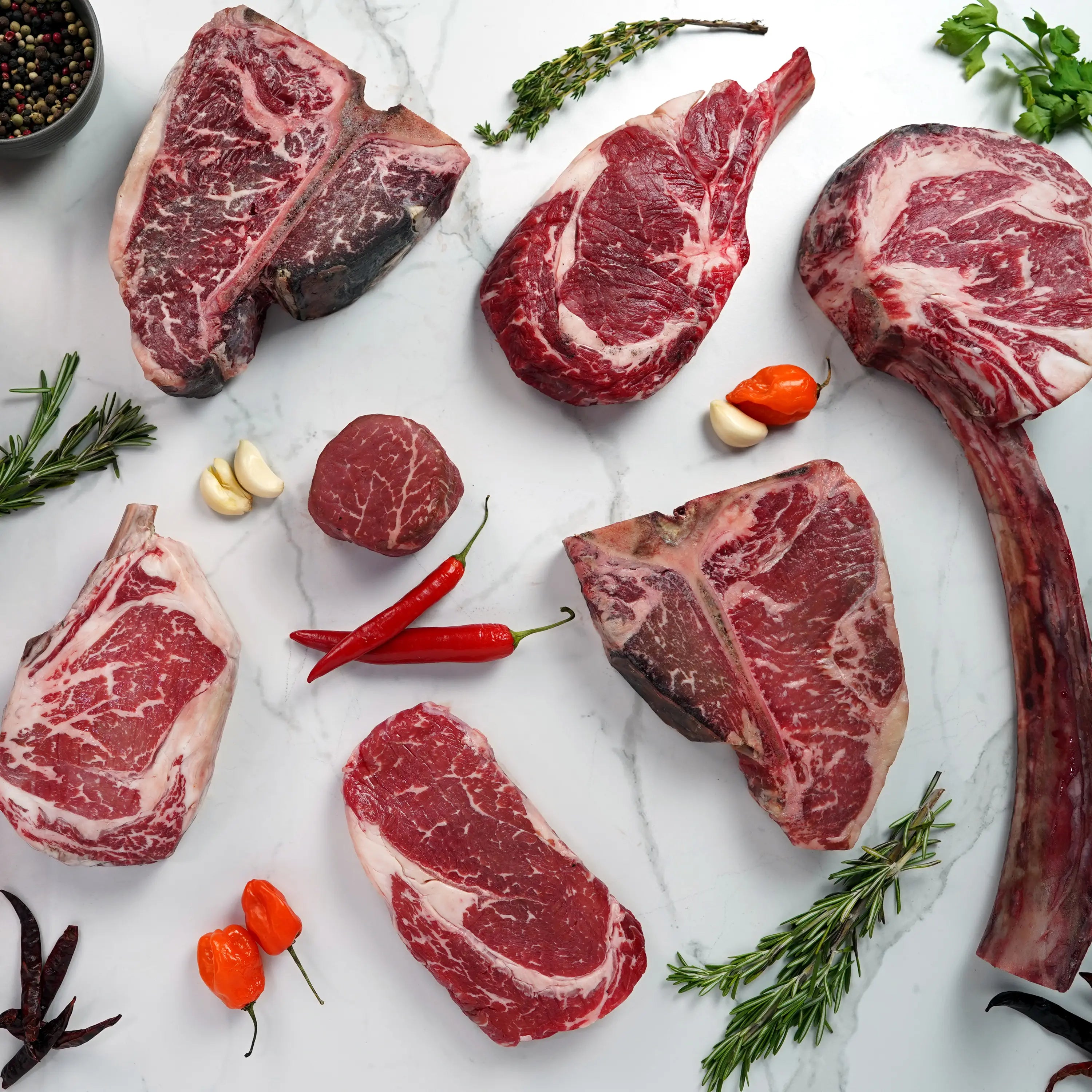
Prime is known as one of the best beef grades on the market because of the meat’s abundant marbling. USDA Prime beef comes from young, well-fed beef cattle that contain lots of evenly distributed fat. All that marbling melts into the steak once the meat hits the heat, essentially basting steaks in their own beefy flavor.
Less than 3% of all beef produced in the U.S. will be given this top-tier grade. If you’re lucky enough to bring home a Prime cut, try a dry-heat cooking method like grilling, roasting, or broiling. The marbling will protect the meat from drying out, and you’ll get to enjoy the beef’s innate deliciousness without the need for braising liquids or lots of other additions — though it’s still fine to baste a Prime steak in butter or top it with herbs, if the mood strikes.
If you love dining out at one of your city’s top steakhouses, it’s very likely you’ll see Prime steak on the menu. Prime, bone-in ribeyes are superstar entrees at fine dining restaurants and 5-star hotel eateries because they offer guests phenomenal flavor and melt-in-your-mouth appeal. USDA Prime steaks will always be denoted as such on a menu — in other words, you’ll never have to guess whether that porterhouse is Prime or not.
Choice Grade
Most steaks on supermarket shelves and on mid-level restaurant menus fall into the Choice category. USDA Choice beef has a good amount of marbling, but the fat is less abundant than you’ll find in Prime beef, and the fat may be less evenly distributed as well.
Around half of all graded beef produced in the United States falls into the Choice grade, making it a relatively easy and affordable find. Choice cuts of meat are versatile and suitable for both dry and moist cooking. You can grill, roast, broil, bake, stew, braise, or fry Choice steaks with delectable results.
Select Grade
Select grade cuts are much leaner with far less marbling compared to higher grades. That makes the meat less tender and juicy compared to Choice and Prime beef, and it’s almost much more prone to drying out during the cooking process. It’s difficult to grill or broil USDA Select cuts without risking a steak that comes out a lot like, well, shoe leather. But you can cook Select beef low and slow — think a lengthy oven braise or even a nifty slow-cooker recipe — and still make a dish that’s a hit for Sunday dinner.
The USDA also offers a couple of other beef grades that aren’t typically seen in restaurants or grocery stores.
- Standard and Commercial graded beef usually shows up at regular and discount supermarkets and may be sold as the store brand.
- Utility, Cutter, and Canner beef is almost never sold as an independent cut (such as a steak) in a retail environment, butcher shop, or restaurant. Instead, these cuts are used to make ground beef and as an ingredient in processed and packaged food products containing meat products (think canned ravioli and corned beef hash).
Yield Grades: Maximizing What You Actually Eat
While USDA quality grades of Prime, Choice, and Select focus on how great your beef will taste, yield grades tell you how much of the carcass turns into the food on your plate.
- Yield Grade 1 means the carcass yields the most closely trimmed, boneless cuts (lean and efficient).
- Yield Grade 5 delivers less saleable meat—more fat, less lean.
USDA graders look at four metrics—fat thickness at the 12th rib, internal fat (kidney/pelvic/heart), ribeye area, and hot carcass weight—and plug these into a formula. The result determines the yield grade, dropping any decimal (so 2.75 becomes YG 2). Typical cutability ranges from about 75 % for YG 1 down to 61 % for YG 5.
So while quality tells you how delicious your steak will be, yield grades help you understand how much steak you can actually get from a beef carcass.
How Does Wagyu Grading Compare to USDA?
Wagyu beef is evaluated using a process that’s completely separate from the USDA’s grading scale. True Wagyu is graded by the Japanese Meat Grading Association (JMGA), which assesses Wagyu based on the strict criteria regarding the meat’s color, fat content/marbling (also known as intramuscular fat, or IMF), and sizing/proportions.
The JMGA rates Wagyu on a scale of 1 to 5 to reflect yield and quality. Within each number grade, there is a secondary range of numbers that reflects the beef’s beef marbling score (BMS).
- 1: Poor Quality (BMS of 1)
- 2: Below Average (BMS of 2)
- 3: Average (BMS of 3-4)
- 4: Good (BMS of 5-7)
- 5: Excellent (BMS of 8-12)
It can be difficult to create a perfect comparison between Wagyu grades and USDA grades, but most say that USDA Prime beef is most similar to A2 or A3 Wagyu in terms of marbling, taste, and tenderness.
Why You Should Care About Beef Grades
The USDA beef grades are not meant to dictate your choice, but rather to provide a clear and concise standard so you know precisely what to expect when you purchase that NY strip steak and start grilling. Whether you know you want the best possible steak for a special dinner for two or you have a recipe in mind and you're looking for some beef to make the cut (pun intended), taking grades into consideration can help you get the most bang for your buck and make your next culinary mission as successful as possible.
Frequently Asked Questions About Beef Grades
What is the best grade of beef to buy?
USDA Prime is the best grade to buy for flavor, tenderness, and juiciness.
Is AAA better than Prime?
No. AAA is a Canadian beef grade that is similar to USDA Choice. Prime is higher in quality with more marbling and better eating characteristics.
What is better, Choice or Prime?
Prime grade is considered better because of its abundant marbling. A Choice steak is still an excellent option that provides great flavor and value.
What is the highest quality meat grade?
USDA Prime is the highest quality grade in the United States beef grading system. It offers the most marbling and consistently delivers the best eating experience.
Is yield grade 1 or 5 better?
Yield Grade 1 is better because it produces the most lean, usable meat. Yield Grade 5 has less lean meat and more fat.
Shop for High Quality Beef at Allen Brothers
Ready to eat? Shop Allen Brothers beef today for artisanal, hand-cut, high-quality, perfectly aged cuts of beef prized by professional chefs and home cooks alike.


